Alternatives to animal use – part 6

Finally, the Freudian slip. Or maybe the last-speech-before-lunch effect. 
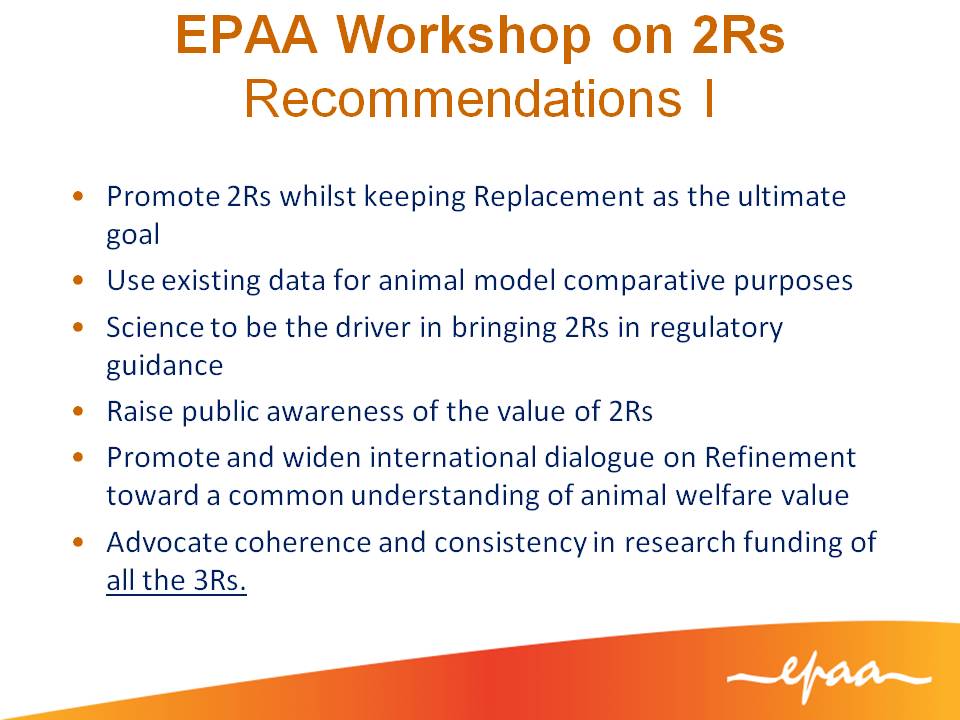
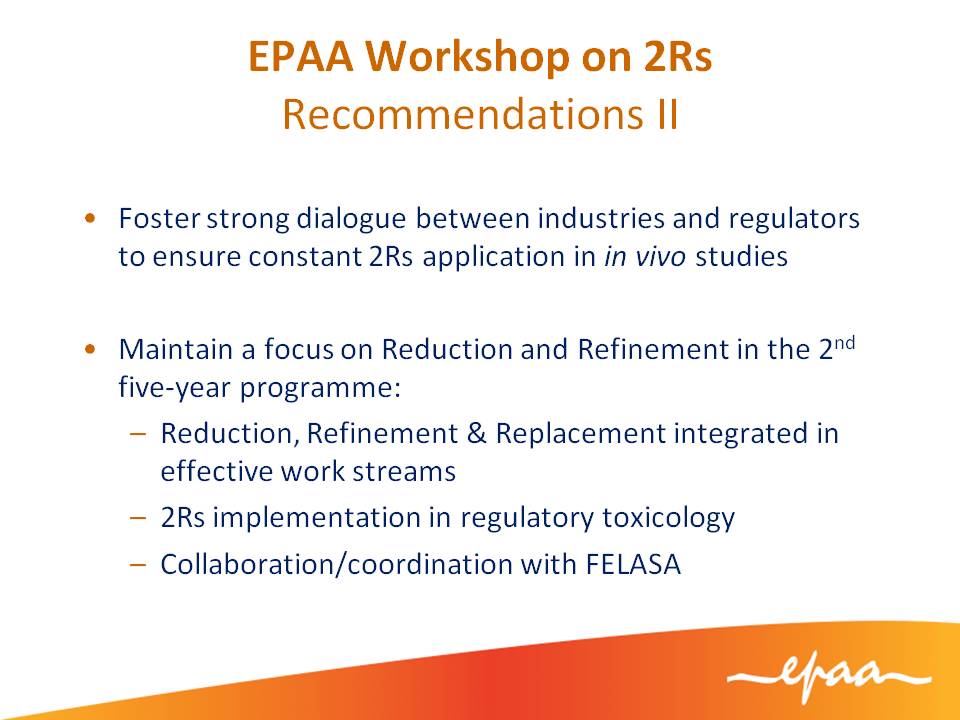
This lecture (all lectures now available here) was given by Gianni Dal Nigro, veterinarian and toxicologist from GlaxoSmithKline. He reported from the EPAA workshop Combining excellence in science and animal welfare, held in October this year, which gave a number of recommendations for the future activity of the EPAA.
Images borrowed from the EPAA website
Typing and listening at the same time, I understood the first of these recommendations (which reads “keeping Replacement as the ultimate goal”) as “skipping Replacement as the ultimate goal”.  I found this really interesting, definitively daring but rather coherent with Richard Fosse’s lecture. So, when  the time for post-lecture questions came, I took the chance to ask more or less the following:
Thank you for a very interesting presentation. I find it interesting that you have decided to skip Replacement as the ultimate goal, and I wanted to ask you if the workshop took this decision because it is not possible to reach replacement in the foreseeable time, or because it is not considered a relevant aim. I will explain why I’m asking the question. As has already been commented on by others, the animal use we are talking about in this conference is only about 10-15% of the total numbers of animals used in experimentation. And if we look at the overall use of animals, it is an even smaller fraction. Interestingly, we never discuss Replacement or even Reduction as regards animal production for human consumption, although the nuimbers are much larger and the amount of suffering is often considerable. Why is it, then, that it’s so important to replace the use of animals in testing? Are we really investing the efforts where they are best needed?
The answer was not very clear, which I now fully well understand, as what I asked must have made no sense whatsoever to the speaker, who had said something completely different. But the question remains. Why is it that using animals in research is such a questionable activity that we ought to make every effort to avoid it, when using animals for food production is reasonably accepted? 
One can turn the question around: why don’t we discuss the 3Rs for animal production? 


Alternative approaches to animal testing – part 5

Or how through a Freudian slip this blogger asked an inconvenient question at the conference. 
Of the talks I was able to follow at the EPAA conference before I had to head for the airport at 15h, there are two I haven’t yet presented. This is of course because they were the two that sparked long chains of thoughts which I had yet to sort out. 
The first was an outstanding – yes, I will be subjective here, I had not heard this speaker before and I was very impressed by the way he delivered a number of subtle but extremely well formulated key messages – talk by Richard Fosse, a veterinarian and laboratory animal scientist who will play a leading role in the EPAA over the next five-year period. Fosse opened by referring to the enormous challenges facing regulatory testing, as industry moves from blockbuster drugs to individualized medicine, and from active substances which are molecules to those which are fragments of proteins and expected to interfere with the action of individual cells. (This means, in more everyday language, drugs which act on increasingly small and specific aspects of the body). The more a drug is designed to act specifically on the body of the patient to be treated, the more difficult it will be to make generalizations from simpler systems or across species. For example, how to test a human-specific antibody fragment to ensure that it is safe for humans? This, argued Fosse, will lead away from the conventional rodent toxicology tests over to the use of humanized mice and primates for studies in which “entire animals are absolutely indispensable”. 
Fosse highlighted that while the EPAA works only on testing, by far most animals – somewhere between 60 and 80% are not used for testing but for research. When exploring new terrain, the challenges as regards the 3Rs and specifically replacement are different – the idea of replacing a process we are still trying to understand is “a semantic trap”. Based on the observation that “academia is totally dependent at the moment and for the foreseeable future on access to animals”, Fosse underlined how crucial it is that the near future focus of EPAA will be on the 2Rs, reduction and refinement. 
Another challenge highlighted is how to measure how effective the 3Rs are, in relation to how much research is being done. “The more we use transgenic animals, the more animals we seem to need”, in what is the typical cycle of research: a new model becomes a new resource through which much more can be explored, it leads to more research which gives new knowledge which can then be used to build alternative approaches. 
It seems Fosse was mainly talking about using animals, rather than about alternative approaches, and about research rather than testing. This may seem odd in the context of the conference but I think there is an important meaning and message. 

Replacement is very selling – successful replacement reflects both scientific and moral progress. Replacement is also consensual – a manifesto which can be signed by scientists and animal rights activists alike. 

But it is precisely in the fact that replacement sells so well that there is a risk. The 2Rs initiative is one illustration of this: specific 3Rs funding goes exclusively to replacement, leaving reduction and refinement to fend for themselves. This is related to the even bigger risk that in well-meaning political correctness we actually oversell replacement. Opponents to the use of animals in research capitalize on this. They argue that scientists are reactionary when defending the use of animals in science, that this is old-fashioned and that replacements are available. We’ve seen it very frequently in the recent discussion in Portugal sparked by the Azambuja animal facility plan. If replacement is possible, then why even thinking of reduction and refinement?
The problem is, to the best of our present scientific knowledge, replacement isn’t possible, at least not throughout and at least not now. (This doesn’t mean all animal use in science is important and morally unquestionable. It may be a perfectly valid moral view to say that we have no right to use animals in science (it’s not a view that I share, but it’s a view I respect). But to say that using animals is oldfashioned and irrelevant because there are alternatives is argue on a very questionable fact base.) And this is a message scientists will have to work hard to be able to sell in a trustworthy way. 
There’s another issue in this, which cropped up informally in the discussion. The EPAA  works exclusively on animal testing, and animal testing is probably the particular black sheep in the public view of animal experimentation. It’s probably also the one part of animal experimentation which is most difficult to defend morally, because the long-term benefit of testing new substances is often mainly economical. But it is also a rather small proportion of animal experimentation – some 10-15%. The largest proportion of experimental animals are used in research, where replacement is much more difficult. To only concentrate efforts to replace the use of animals in what is already a minor proportion of overall numbers may be seen as disproportionate. 
Even more so as the number of animals used for experimentation is only a very small fraction of the total number of animals used for human benefit. Which takes me to my Freudian slip.
(to be continued)

Animal welfare in Europe or Alternatives to animal use – part 4

“Animal welfare is a very important European issue. Animals have rights”. These were the words of European Commissioner John Dalli, Health and Consumer Policy, in his opening speech at the EPAA conference. 
It is sometimes refreshing, sometimes frustrating for an academic researcher to hear a non-academic state as a fact what we may spend careers discussing, questioning and redefining. In this particular case, I’m not sure how much more we can get from discussing whether animals are the sort of beings that can have rights. (Although I couldn’t help recalling the discussion developing in Portugal two years ago when lawyer and centre-right *politician Paulo Rangel provocatively declared Animais não têm direitos – Animals don’t have rights).
But I know it’s important that a European Commissioner states that animal welfare is a very important European issue. This means that the issue is on the European agenda and that we can expect more EU activities focusing on animal welfare. This is clearly visible in the EU animal welfare policy, which Dalli highlighted.
*More specifically, Member of the European Parliament for PSD, the party once led by present European Commission president José Manuel Durão Barroso

Alternative approaches to animal testing – part 3

Blogging directly from the meeting room is exciting and inspiring but challenging and – not surprisingly! – not fully compatible with engaging in the discussion. Computer at hand, I could at least write down fragments to use when actually composing the remaining posts on the plane back. Here’s what the second session was about:
Friedlieb Pfannkuch, Roche, gave an international perspective on initiatives to promote and implement the 3Rs in regulatory testing. He showed the long list of which are legally required before a new drug can be launched on the market . A powerful illustration of what a challenge it is to make changes here, because so many changes are needed. Essentially, Pfannkuch was arguing for developing increasingly sophisticated approaches in which one looks at how small doses affect critical processes in animals, and for the systematic improvement of the reliability of safety tests (animal and non-animal tests alike) in accurately predicting what will happen in humans.
David Gallacher, Johnson& Johnson, presented one such initiative: the animal model framework. Through a series of teleconferences and sharing of data, several pharmaceutical companies work together to evaluate how good different tests are at making accurate predictions, and how they can be improved in this sense. The first results of this initiative are expected to be published in the beginning of 2011.
Ngaine Dennison from the UK Home Office presented the results of a 15-year preoccupation with reduction and refinement initiatives within one single test: the mouse bioassay for shellfish toxin. An illustrative example of how one can reason in this situation by combining scientific/technical and practical/economical considerations.  This means asking questions like
  • Can we administer the sample in a way that causes less harm to the animals?
  • Can we reduce the duration of the test? 
  • Can we anaesthetize the animals to reduce suffering?
Joanna Edwards from the not-for-profit organizaton Lhasa limited presented the existing databases and softwares for data sharing in the life sciences. The idea behind this type of initiatives is to bring together existing information about substances into large and sophisticated databases. The more complete and versatile such databases are, the further they can be used to make predictions.

Alternative approaches to animal testing – part 2

Right now, Timo Nevalainen from the University of Eastern Finland is opening the second morning session, on the 2Rs in regulatory testing. The 2Rs is the central theme of this year’s conference and stands for Reduction and Refinement – that is the 2Rs which applies when animals are actually used rather than being replaced. This is an important notion and I think there’s quite some tension here between a politically correct but not necessarily realistic focus in the official discourse.

Two of this morning’s speakers made this tension very evident. Emily McIvor from Humane Society International stressed that the ultimate goal must be replacement and Richard Fosse from EPAA stressed that in the foreseeable future we will continue to need to do research on entire animals. Both of these statements are probably right – but what frustrates many laboratory animal scientists today is that strategic funding initiatives are very biased towards replacement. But only to fund research on replacement is rather much like only funding research into alternative car fuels and ignore efforts to reduce the pollution from existing combustion engines. Moreover, it’s probably deceiving the public into believing that replacement of animal research is really around the corner.

The 2Rs initiative which Timo Nevalainen headed a couple of years ago was an attempt to change this. In a document signed by some 50 scientific societies and animal welfare associations, the European Commission was asked to consider funding Reduction and Refinement research in the 7th Framework Program for research. It wasn’t successful -still Replacement is the only one of the 3Rs which have dedicated funding from the European Commission.

Alternative approaches to animal testing – part 1

Today I’m blogging live from Brussels, from the annual conference of the European Partnership for Alternative Approaches to Animal Testing. This is a collaboration between the European Commission and industry to promote alternatives. 

Before going on to reporting from the different talks, let me clarify two key issues:

Animal testing is a very specific part of the larger concept of animal use for scientific and other experimental purposes. It means the use of animals to test substances (pharmaceutical drugs, industry chemicals etc) in order to evaluate whether it is safe to use these substances for the purpose they are intended. Research which is intended to develop those substances or understand how they can be used to treat diseases in the case of drugs, or to kill insects in the case of pesticides, is not animal testing.

Alternative approaches is a tricky expression. Alternatives are not only those which replace animals, but also those that reduce the number of animals and those that refine the way animals are used so that suffering is minimized. That is, all the 3Rs as defined by Russell and Burch in 1959 are considered alternatives.

O caso das galinhas cegas

Texto escrito por Ana Margarida Costa, Diva Oliveira e Sónia Saraiva, alunas no Curso de Pós-Graduação em Bem-Estar Animal, ISPA

O sofrimento põe de forma inequívoca em causa a integridade e dignidade dos seres sencientes. Se podemos diminuir a dor ao custo de outros aspectos da integridade fisica, será um objectivo desejável?

Vemoso caso das galinhas cegas. Aqui, Costa et al. (2001)* dá-nos conta da utilização da técnica do corte de bico para prevenção do canibalismo e picacismo entre galinhas poedeiras em sistemas de produção intensivos, sendo estes comportamentos predominantes entre galinhas com plumagem castanha. Estes problemas têm uma origem multifactorial englobando as condições de criação, de alimentação e de manutenção tornando difícil o seu controlo.

O corte do bico constitui um procedimento doloroso para as galinhas e pode resultar numa privação sensitiva permanente e definitiva. Uma solução alternativa consiste na reprodução selectiva a partir de uma mutação espontânea que origina galinhas cegas que não mostram tendência para nenhum dos comportamentos apontados. Não existe alteração na produção precoce de ovos e apesar de haver uma diminuição de cerca de 25% de consumo de alimento, como são menos activas mantêm os seus níveis de peso. No entanto, como a visão é um dos sentidos mais importantes para as aves, há um risco considerável que as galinhas cegas deixem de ter os comportamentos normais da espécie como o “banho-de-pó” e têm dificuldade em alimentar-se.

Aparentemente, o procedimento de cortar o bico por ser doloroso põe em causa o bem-estar animal, parecendo ignorar qualquer código moral e ético da relação homem/animal. Segundo J. Bentham (1748-1832) quando se preocupa com o bem-estar de alguém não interessa se ele pensa ou raciocina, mas sim se sente ou consegue manifestar de algum modo o seu sofrimento mesmo sem falar. À primeira vista parece evidente existir apenas uma preocupação economicista, uma vez que o canibalismo causa a morte de alguns animais acarretando prejuízo para a exploração. Contudo, pode estar presente também uma preocupação ética animal, na medida em que existe o desejo de minimizar o sofrimento que os animais causam uns aos outros. Este caso suscita assim alguma ambiguidade, levantando algumas questões. O que provocará maior dor, o canibalismo e picacismo, ou o corte do bico? Ou será que um enriquecimento do meio ambiente seria suficiente para evitar os comportamentos agressivos?

A reprodução selectiva de modo a originar galinhas cegas, numa lógica puramente utilitarista constituiria um bem e deveria ser incentivada, ao passo que, do ponto de vista da integridade psicofísica do animal, representaria uma forma de mutilação, impedindo o uso de um dos orgãos para o fim que evoluiu. Além disso, sob o ponto de vista do bem-estar animal existiu uma interferência humana que impede o animal de ter uma vida própria dos da sua espécie. E seguramente, os ancestrais selvagens das galinhas usavam a visão para a generalidade dos seus comportamentos, desde a procura de alimento até à fuga de predadores. Tom Regan lembrou que se “os animais são sujeitos à vida” têm direito à sua própria vida e não àquela que achamos melhor para eles. O maneio de animais de produção e de consumo em explorações intensivas, que P. Singer (1975) descreve como “a granja-fábrica”, justifica-se, se considerarmos que a humanidade necessita de proteínas animais. No entanto, nessas explorações, é essencialmente contemplado o factor custo/benefício a par dos aspectos técnicos, económicos e de rentabilidade da produção, sendo descurados os aspectos étnicos e morais no maneio e utilização dos animais, o que nos leva de imediato a questionar se será ou não lícito e moralmente aceite manipulá-los de acordo apenas com os interesses dos seus proprietários.

A questão ética de adaptar os animais às condições de manutenção através da criação selectiva ou do corte do bico, tem como alternativa adaptar tais condições às necessidades nos animais. Pensamos que a relação homem/animal, do ponto de vista ético seria mais equilibrada se fosse de facto possível melhorar as condições ambientais e sociais. Tal seria possível melhorando e enriquecendo as instalações e os espaços de permanência das galinhas, de modo a que estivessem menos animais em cada espaço e que estes pudessem manifestar comportamentos normais de vida livre. Desta forma, contribuir-se-ia para a diminuição dos níveis de stresse e de ansiedade nestes animais que despoletam comportamentos de agressividade como o canibalismo e o picacismo.

A ética empresarial sobrepôs-se assim à ética animal.


*Costa et al 2001 BIOÉTICA PARA AS CIÊNCIAS NATURAIS, compilação de conferências e casos de estudo do FLAD/NSF International Bioethics Institute, coordenado por Humberto D. Rosa

Violência contra animais – um sinal de alerta?

Texto escrito por Carla Abreu, Filipa Alves, Inês Gaspar e Rute Coelho, alunos do curso de Pós-Graduação em Bem-Estar Animal, ISPA.

O Homem é um ser violento por natureza, ou melhor, a violência faz parte da natureza do Homem. Mas quando se transforma em violência gratuita e arbitrária, podemos dizer que ganha contornos de doença (e sendo assim há quem diga que a humanidade anda, mental e emocionalmente, doente).
Noe Estados Unidos, o fenómeno da violência gratuita sobre animais tem vindo a receber uma atenção crescente por investigadores de ramos tão distintos como polícia, ciência forense, psicologia e etologia (humana e animal). Observam uma correlação entre  casos de violência cruel sobre animais, e casos de violência sobre pessoas, sejam elas outras ou o próprio. Actos de violência sobre animais servem, assim, de sinal de alerta para possíveis situações de violência sobre outros (violações, tráfico de droga, abuso infantil, entre outras) e o facto de se crescer em ambiente violento torna mais provável que se inflijam actos de extrema violência, sobre animais. 
Mas, como relata Charles Siebert num artigo de New York Times em Junho 2010, é possível juntar animais com pessoas com historial violente num projecto com contornos positivos. 

To date, one of the most promising methods for healing those whose empathic pathways have been stunted by things like repeated exposure to animal cruelty is, poetically enough, having such victims work with animals. Kids who tend to be completely unresponsive to human counselors and who generally shun physical and emotional closeness with people often find themselves talking openly to, often crying in front of, a horse — a creature that can often be just as strong-willed and unpredictable as they are and yet in no way judgmental, except, of course, for a natural aversion to loud, aggressive human behaviors. (…) 
For Lockwood, animal-therapy programs draw on the same issues of power and control that can give rise to animal cruelty, but elegantly reverse them to more enlightened ends. “When you get an 80-pound kid controlling a 1,000-pound horse,” he said, “or a kid teaching a dog to obey you and to do tricks, that’s getting a sense of power and control in a positive way. We all have within us the agents of entropy, especially as kids. It’s easier to delight in knocking things down and blowing stuff up. Watch kids in a park and you see them throw rocks at birds to get a whole cloud of them to scatter. But to lure animals in and teach them to take food from your hand or to obey commands, that’s a slower process. Part of the whole enculturation and socialization process is learning that it’s also cool and empowering to build something. To do something constructive.”»

O objectivo é de  reverter o processo e fazer a pessoa perceber que pode direccionar essas pulsões violentas e a necessidade de controlo e poder, para fins mais construtivos. É extremamente importante trabalhar nesse sentido, a fim de criar equilíbrio e harmonia entre pessoas e entre pessoas e animais, a fim de sanar a sociedade.

Dono ou guardião?

“Some animal advocates don’t like the word ‘pet’. They find it demeaning to the animals we live with. They want us to call our furry, finned and winged friends companion animals and their owners guardians. (…)
I don’t particularly like the word companion animal. Many pets are not true companions. When my friend Joe Bill was a child, his favorite pet was a crawfish that lived in a bowl next to his bed. Pet? Yes. Companion? No?
Substituting the term guardian for pet owner is also problematic. Unlike the guardian of a human child, a pet’s guardian is allowed to give away, sell, or sterilize their ward against its will. They can even have their companion animal euthanized if they tire of it. The terms companion animal and pet guardian are linguistic illusions that enable us to pretend we do not own the animals we live with”
A argumentação é do Hal Herzog, psicólogo norte-americano que teve um papel pioneiro no desenvolvimento da investigação das interacções entre humanos e outros animais, human-animal studies, e a citação do mais recente livro dele Some we love, some we hate, some we eat.
O termo pet não é limitado para os animais que partilham a nossa vida e tem um uso mais geral para descrever algo que é tratado com especial carinho. É também um verbo: to pet somebody quer dizer dar festinhas a alguém (não deve ter sido isso que Joe fez com o peixe). Enquanto a distinção entre dono e guardião é igualmente relevante para o português, o termo predominante parece claramente ser animais de companhia e não, por exemplo, mascote.
Preciosismos linguísticos à parte, há aqui uma questão de natureza moral. Hal Herzog acha que a realidade é a realidade e não vale a pena pintá-la de cor-de-rosa. Mas será que é isto que os activistas pretendem, ou querem propor uma alteração de terminologia a ser seguida por uma alteração de prática?
Somos tanto donos dos nossos animais de companhia como somos de uma bicicleta ou de uma cadeira?

Comer ou não comer?

O principio das 5 Liberdades estabelece que para estar bem, um animal deve estar livre de fome e de sede. É óbvio – quem põe em causa a importância disto para o bem-estar animal? Mas, como qualquer afirmação simplificada, está aberta à interpretação. 
Animais de diferentes espécies têm hábitos diferentes de alimentação natural, moldados pela seleção natural e representando adaptações diferentes a um ambiente particular. Um herbívoro em pastejo pode gastar uma grande proporção de seu período ativo a comer de facto, estilo cortador de relva. Outros herbívoros são browsers, dividindo seu tempo entre a procura de alimentos particularmente nutritivos e a ingestão deles. Outros ainda acumulam comida para uso posterior. Em todos os casos, um animal pode ter mais ou menos sucesso em encontrar alimentos. É talvez mais evidente no caso dos predadores, que terão que detectar, captar, atacar e matar uma presa, a fim de garantir uma refeição. (Na verdade, esse é um dos casos em que realmente faz sentido falar de uma refeição – um termo pouco relevante no caso de uma vaca ou um cavalo, quando deixados de se alimentar segundo a sua natureza.) 
Padrões de alimentação naturais à parte, a forma como os animais em cativeiro comem muitas vezes é determinada pela forma como eles são alimentados. No caso de alguns animais de produção, crescem tão rapidamente ou produzem tanto que a sua alimentação é limitada apenas pela sua capacidade de ingerir e digerir. Este é o caso de frangos de engorda e vacas leiteiras no pico da lactação (e estas ultimas mesmo assim podem não conseguir comer o suficiente). Fornecendo uma dieta concentrada sem restrição (ad libitum) vai, porém, tornar a maior parte dos animais obesos. E, assim como nos seres humanos, a obesidade leva a problemas de saúde secundários – a razão pela qual existe agora uma discussão veterinária e ética sobre a obesidade em animais de companhia como cães e gatos. Recentemente, as autoridades suecas de protecção animal ameaçaram prender um cão demasiado obeso, e para manter o seu cão, os donos têm que o sujeitar a um controle de saúde e peso.  
Outro grupo de animais que, se vivem o tempo suficiente, desenvolve problemas de peso são os animais de laboratório. Principalmente por razões práticas, é habitual dar comida ad libitum a ratos de laboratório. É a maneira mais conveniente de assegurar que cada animal recebe o que necessita (mesmo que seja à custa de alguns, ou mesmo a maioria deles, receber mais do que deveriam). Em alguns estudos de aprendizagem, os animais recebem uma recompensa de alimento, após completar com sucesso a tarefa. Naturalmente, uma recompensa de alimento é vista apenas como uma recompensa se o animal está motivado para comer. Se alguém me oferece uma maçã quando eu acabei de terminar um almoço de sopa, prato e sobremesa, não vou estar particularmente interessada – mas três horas mais tarde posso alegremente desembolsar dinheiro para pagar a mesma maçã. Por isso, é habitual restringir a quantidade de alimento fornecido aos animais em estudos de aprendizagem e memória. Muitas vezes recebem a quantidade de comida que irá mantê-los em 80% do peso de um animal semelhante alimentado ad libitum. No caso dos roedores de laboratório, o alimento pode ser dado uma ou duas vezes por dia, e quando terminar não terão mais até a próxima refeição. Quando aplicamos esses protocolos no laboratório, os nossos animais estão sem comida por algumas horas por dia.  
Esta é uma violação do paradigma das 5 Liberdades? Um problema de bem-estar animal? Será diferente da situação da escola, onde as crianças não podem petiscar na sala de aula e só podem comer durante as pausas do meio da manhã, almoço e meio da tarde? 
No caso de animais de laboratório, alimentação ad libitum pode de facto ser um problema científico. “Roedores ‘control’ do laboratório são metabolicamente mórbidos”, declarou Mark Mattson e colegas num artigo scientífico em 2009, argumentando que a obesidade dos animais reduz a validade científica da investigação. Se defendemos que a aceitabilidade ética da experimentação animal depende, em parte, do benefício que ela proporciona, reduzindo o benefício é uma questão ética e, consequentemente, como os animais são alimentados também se torna uma questão de relevância ética. Claro que isto é uma consideração do ponto de vista completamente humano. Mas, no caso de animais de companhia, há um verdadeiro conflito de interesses para o próprio animal. O mesmo cão tem um interesse imediato na obtenção de um petisco da mesa ou uma porção extra da lata. Mas tem também um interesse de longo prazo, em não desenvolver diabetes ou problemas articulares. 
Os seres humanos podem ser capazes de fazer uma escolha consciente entre favorecendo interesses imediatos ou a longo prazo (embora longe de todos consigam seguir na prática à mesma decisão), mas não podemos perguntar aos animais a sua preferência. Sendo responsáveis por eles temos, nós, que fazer a escolha. Qual será a sua?
Ler mais