Or how through a Freudian slip this blogger asked an inconvenient question at the conference.
Of the talks I was able to follow at the EPAA conference before I had to head for the airport at 15h, there are two I haven’t yet presented. This is of course because they were the two that sparked long chains of thoughts which I had yet to sort out.
The first was an outstanding – yes, I will be subjective here, I had not heard this speaker before and I was very impressed by the way he delivered a number of subtle but extremely well formulated key messages – talk by Richard Fosse, a veterinarian and laboratory animal scientist who will play a leading role in the EPAA over the next five-year period. Fosse opened by referring to the enormous challenges facing regulatory testing, as industry moves from blockbuster drugs to individualized medicine, and from active substances which are molecules to those which are fragments of proteins and expected to interfere with the action of individual cells. (This means, in more everyday language, drugs which act on increasingly small and specific aspects of the body). The more a drug is designed to act specifically on the body of the patient to be treated, the more difficult it will be to make generalizations from simpler systems or across species. For example, how to test a human-specific antibody fragment to ensure that it is safe for humans? This, argued Fosse, will lead away from the conventional rodent toxicology tests over to the use of humanized mice and primates for studies in which “entire animals are absolutely indispensable”.
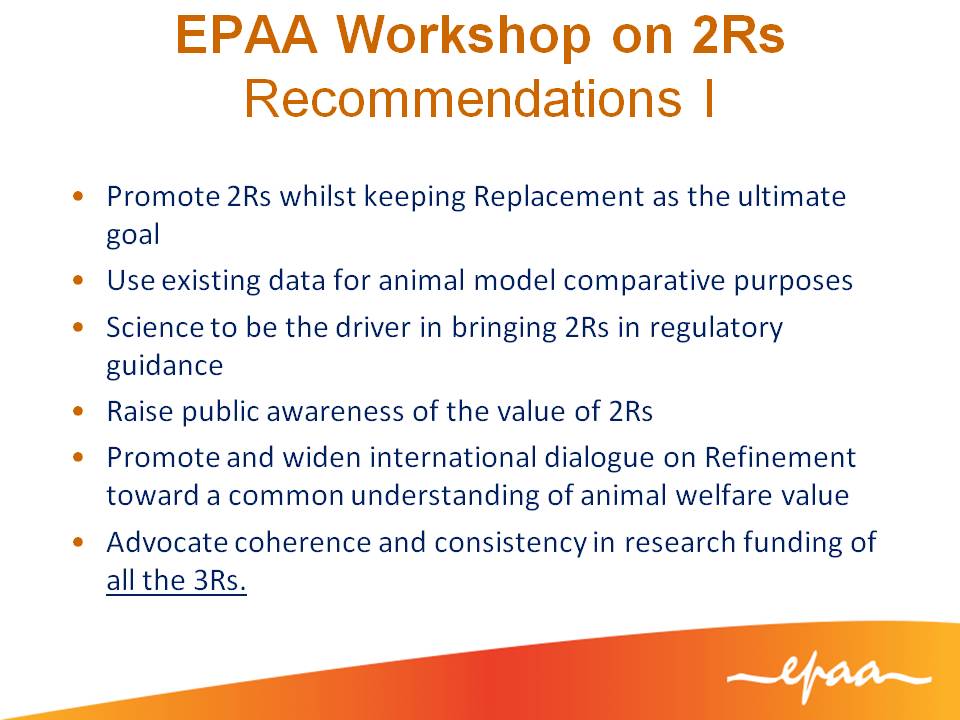
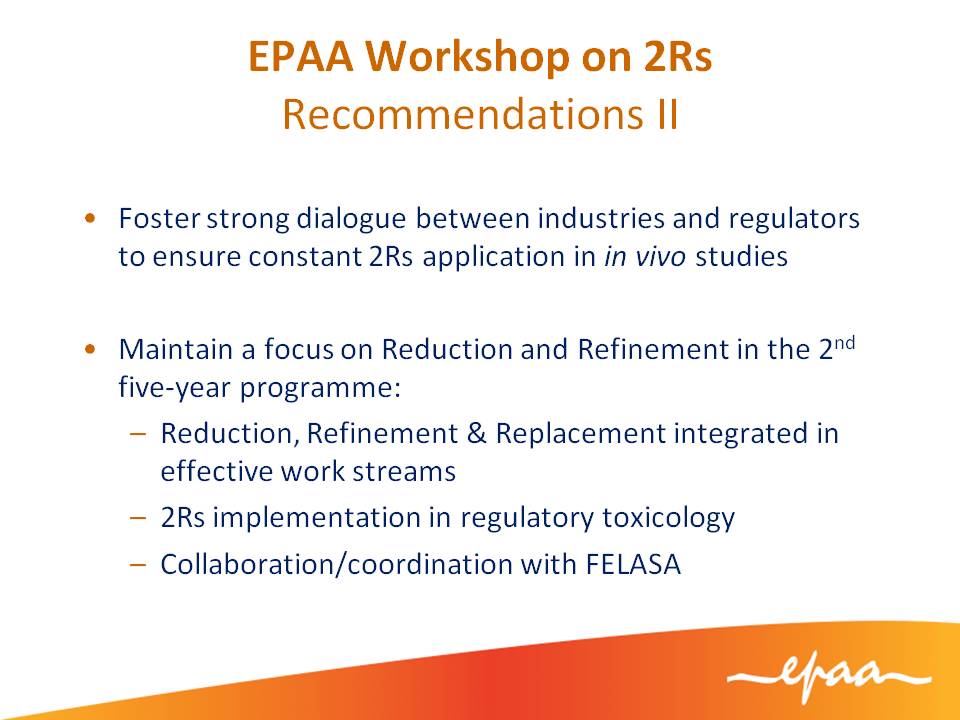
Fosse highlighted that while the EPAA works only on testing, by far most animals – somewhere between 60 and 80% are not used for testing but for research. When exploring new terrain, the challenges as regards the 3Rs and specifically replacement are different – the idea of replacing a process we are still trying to understand is “a semantic trap”. Based on the observation that “academia is totally dependent at the moment and for the foreseeable future on access to animals”, Fosse underlined how crucial it is that the near future focus of EPAA will be on the 2Rs, reduction and refinement.
Another challenge highlighted is how to measure how effective the 3Rs are, in relation to how much research is being done. “The more we use transgenic animals, the more animals we seem to need”, in what is the typical cycle of research: a new model becomes a new resource through which much more can be explored, it leads to more research which gives new knowledge which can then be used to build alternative approaches.
It seems Fosse was mainly talking about using animals, rather than about alternative approaches, and about research rather than testing. This may seem odd in the context of the conference but I think there is an important meaning and message.
Replacement is very selling – successful replacement reflects both scientific and moral progress. Replacement is also consensual – a manifesto which can be signed by scientists and animal rights activists alike.
But it is precisely in the fact that replacement sells so well that there is a risk. The 2Rs initiative is one illustration of this: specific 3Rs funding goes exclusively to replacement, leaving reduction and refinement to fend for themselves. This is related to the even bigger risk that in well-meaning political correctness we actually oversell replacement. Opponents to the use of animals in research capitalize on this. They argue that scientists are reactionary when defending the use of animals in science, that this is old-fashioned and that replacements are available. We’ve seen it very frequently in the recent discussion in Portugal sparked by the Azambuja animal facility plan. If replacement is possible, then why even thinking of reduction and refinement?
The problem is, to the best of our present scientific knowledge, replacement isn’t possible, at least not throughout and at least not now. (This doesn’t mean all animal use in science is important and morally unquestionable. It may be a perfectly valid moral view to say that we have no right to use animals in science (it’s not a view that I share, but it’s a view I respect). But to say that using animals is oldfashioned and irrelevant because there are alternatives is argue on a very questionable fact base.) And this is a message scientists will have to work hard to be able to sell in a trustworthy way.
There’s another issue in this, which cropped up informally in the discussion. The EPAA works exclusively on animal testing, and animal testing is probably the particular black sheep in the public view of animal experimentation. It’s probably also the one part of animal experimentation which is most difficult to defend morally, because the long-term benefit of testing new substances is often mainly economical. But it is also a rather small proportion of animal experimentation – some 10-15%. The largest proportion of experimental animals are used in research, where replacement is much more difficult. To only concentrate efforts to replace the use of animals in what is already a minor proportion of overall numbers may be seen as disproportionate.
Even more so as the number of animals used for experimentation is only a very small fraction of the total number of animals used for human benefit. Which takes me to my Freudian slip.
(to be continued)

 Animalogos